


Top Bridal Manufacturers in China for Private Label & ODM (2026 Guide)
- Rui Cai

- Jan 17
- 4 min read
I’ve lost count of how many times I’ve heard some version of this from a bridal shop owner:
“I’m not scared of China. I’m scared of surprises.”
And honestly? That’s fair.
In a boutique, your reputation is built appointment by appointment. One gown that shows up different from the sample, one missing accessory, one undocumented change… and suddenly you’re not just managing a delivery. You’re managing trust.
So this guide isn’t a hype piece. It’s a practical way to think about bridal manufacturers in China for private label and ODM—what “top” actually means in 2026, and how to spot it fast.

Private Label vs ODM: what you’re really buying
Most buyers use these terms interchangeably, but they behave differently in real life.
Model | What it usually means | Best for | Where mistakes happen |
Private Label | You pick existing styles (sometimes with boutique-specific spec notes) and sell under your label | Fast assortment build, proven silhouettes | “Small changes” not documented clearly |
ODM | Manufacturer develops designs (or co-develops) and you label them | Differentiation, trend response, boutique exclusives | Design intent lost during production handoff |
OEM | You provide a full design/tech pack; factory executes | Established brands with tech packs | Pattern/fit interpretation + sample-to-bulk gaps |
If you want fewer surprises, the best partners treat all three as the same rule: everything traceable, nothing assumed.
What “top” means for bridal manufacturers in 2026
In 2026, “top” isn’t just pretty photos and a big showroom.
A top manufacturer is the one who can prove—on camera and in documents—that they control the details you care about:
Table: The 2026 buyer scorecard (what to verify early)
What to verify | Why it protects your sell-through | How to check quickly |
Sample-to-bulk consistency | You can’t sell what won’t match the sample | Ask for a change log + sample approval checkpoints |
Embedded QC (not “final check only”) | Most issues start early (materials/cut/sew) | Ask to see QC points from incoming → final inspection |
Traceability of changes | Prevents “we decided for you” moments | Require written confirmation for every change |
Clear packing documentation | Prevents missing items & confusion | Ask for packing list format + pre-ship verification step |
Communication cadence | Reduces anxiety and decision drift | Agree on updates at key production milestones |
Design + production alignment | Keeps the gown looking like the concept | Ask who signs off: pattern, construction, finish |
If a factory can’t show you these basics, you’re not buying capability—you’re buying hope.

Why boutique buyers keep asking for the same “safe” features
Here’s what I’m hearing most often as boutiques plan 2026 buys: brides want security and comfort without losing the premium look.
That translates into consistent demand for:
supportive bodices that feel stable
cleaner necklines (including higher neck options)
lighter builds for warm-weather markets
versatile details that help stylists pivot in-room
Trends shift, but the underlying request stays the same: “Make it easy for me to say yes.”
The fastest way to vet bridal manufacturers in China for private label and ODM
If you’re short on time, don’t start with a long email thread. Start with proof.
Here’s a simple 3-step approach that saves boutique buyers weeks:
Ask for a live walkthrough (virtual is fine)You’re looking for real production flow, not a highlight reel.
Ask for one sample pathway explained end-to-endMaterials → cutting → sewing → mid-check → finishing → final inspection → packing verification.
Ask how changes are handledNot “can you do it,” but “how do you document it, approve it, and prevent it from happening twice?”
If they can answer clearly, you’re probably in the right place.
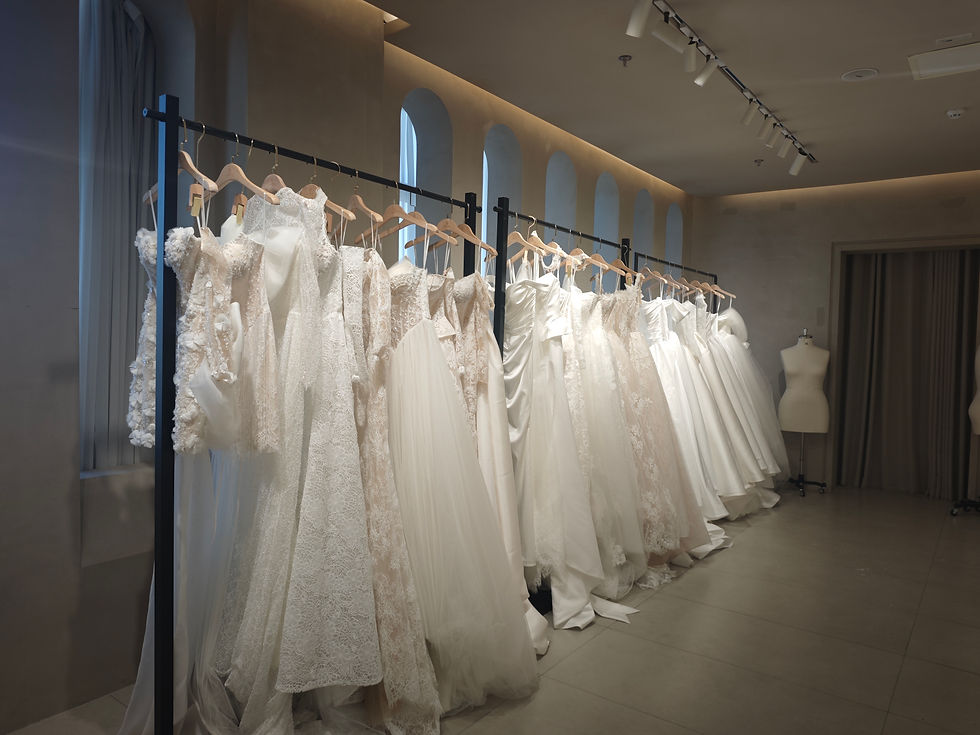
What we do at Huasha Bridal (and why boutiques stay with us)
At Huasha Bridal, we’ve built our work around one idea: quality is our lifeline—and quality isn’t a department, it’s a system.
That’s why our QC is embedded across the full workflow, with seven key checkpoints from incoming materials to final inspection:
Raw material control (fabric, lace, beads, trims checked before inventory)
Cutting inspection (piece accuracy + clean edges)
Sewing inspection (seams, tension, finishing discipline)
In-form check (silhouette + proportion + key measurements)
Decoration inspection (security + symmetry + durability)
Placement/draping inspection (consistency of lace placement and draping effects)
Final inspection (cleanliness, completeness, function checks, labeling)
Separately, we’re also obsessive about documentation—because “it looks nice” is not the point if it isn’t what you ordered. For boutique buyers, certainty beats pretty every time.
2026 note: high-neck styles are part of our new season direction
In our 2026 latest season, we’re actively developing more high-neck options because we keep hearing the same boutique feedback: brides want a neckline that feels secure, elegant, and photogenic—without the fuss.
We also support boutique-specific spec adjustments (neckline height, sleeve pairings, lace density, comfort finishing) and we’ll keep building more high-neck designs based on trend movement and bridal shop owner feedback.
Explore Huasha Bridal here: https://www.huashabridal.com/
Quick takeaway
If you’re sourcing in 2026, don’t ask “Who’s the biggest factory?”
Ask:
Can they prove consistency?
Can they document every change?
Can they show embedded QC?
Can they communicate like a partner, not a mystery?
That’s what defines the best bridal manufacturers in China for private label and ODM—and that’s what protects your boutique’s trust.


Comments