
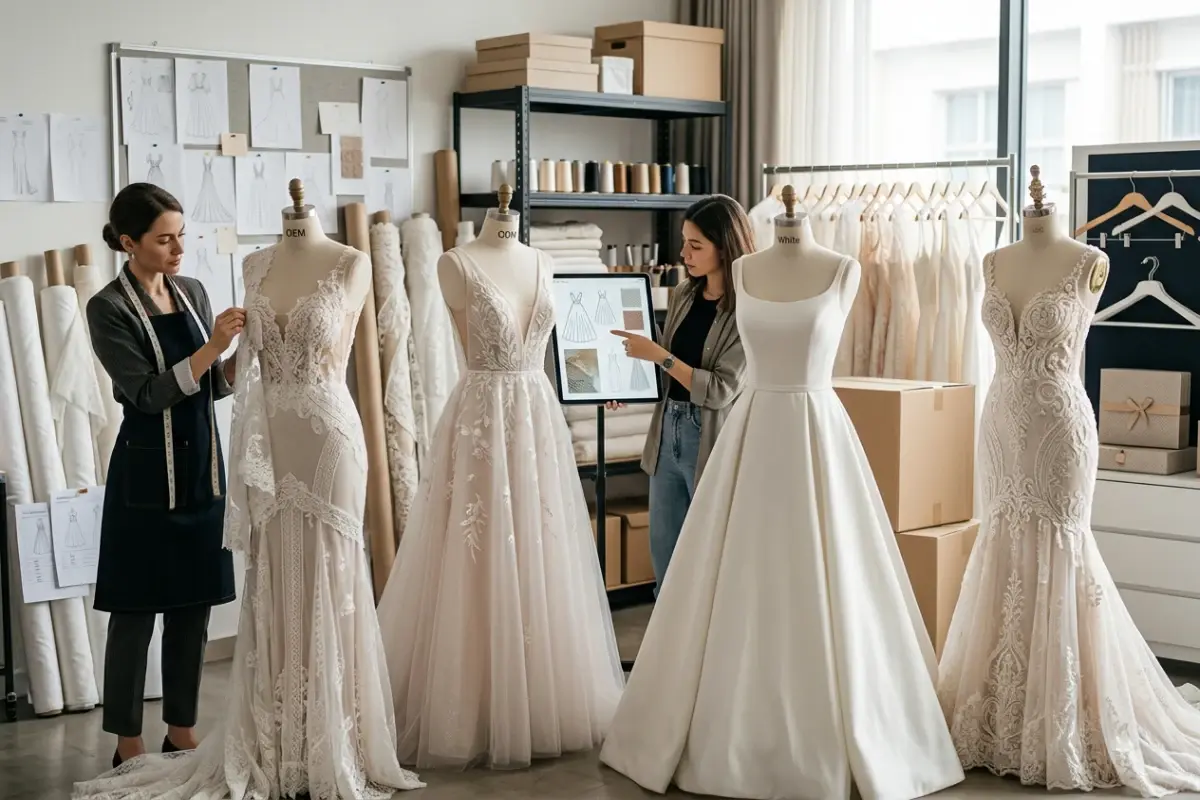
OEM vs. ODM vs. White Label vs. Private Label Wedding Dresses: Complete Guide

The fundamental difference between OEM ODM white label and private label wedding dresses centers on design ownership, customization depth, and brand exclusivity. OEM manufactures custom dresses from buyer-provided designs, whereas ODM offers ready-made factory collections with optional modifications. White label supplies generic, non-exclusive gowns to various retailers, while private label enables bridal boutiques to sell exclusive, customized collections under their own brand.
What Is the Difference Between OEM, ODM, White Label, and Private Label Wedding Dresses?
Choosing the proper production model determines how much control a bridal boutique maintains over design, branding, and collection exclusivity. Each model caters to distinct business strategies, budgets, and operational capabilities.
Manufacturing Model | Design Origin | Customization Scope | Brand Exclusivity | Ideal For |
|---|---|---|---|---|
:--- | :--- | :--- | :--- | :--- |
OEM (Original Equipment Manufacturer) | Buyer / Boutique | Complete custom fabrication | Fully exclusive to the buyer | Established bridal brands and designers with custom sketches |
ODM (Original Design Manufacturer) | Factory / Manufacturer | Minor adjustments to factory designs | Non-exclusive or regionally limited | Retailers seeking fast sourcing from pre-designed catalogs |
White Label | Factory / Manufacturer | Minimal (relabeling existing stock) | Non-exclusive across multiple shops | Shops needing quick, generic inventory at low overhead |
Private Label | Factory / Retailer Collaboration | Moderate to high design & branding customization | Exclusive to the boutique or chain | Mid-to-high-end boutiques building an exclusive house brand |

OEM bridal manufacturing relies on detailed client tech packs and custom pattern development.
What Does an OEM Bridal Manufacturer Provide for Boutiques?
An OEM bridal manufacturer produces wedding gowns strictly based on technical packages, sketches, measurements, and fabric specifications supplied by the buyer. Under this arrangement, the boutique or designer owns the design rights entirely.
Key aspects of the OEM model include:
Proprietary Design Rights: The retailer retains full intellectual property for all dress patterns and silhouettes.
Tailored Material Selection: Boutiques specify exact laces, tulles, embroideries, inner structures, and finishes.
Custom Development Steps: Production involves pattern grading, sample development, and buyer approvals before manufacturing bulk orders.
High Brand Differentiation: Every gown is distinct to the retailer, preventing direct product duplication by competitors.
How Does ODM Wedding Dress Production Benefit Bridal Retailers?
In ODM wedding dress production, the manufacturer develops complete seasonal bridal styles in-house. Retailers can select gowns directly from the factory's pre-existing catalog rather than creating original designs from scratch.
Advantages of selecting ODM bridal manufacturing include:
Reduced Design Overhead: Boutiques do not need in-house patternmakers or fashion design teams to introduce fresh styles.
Streamlined Production: Because standard patterns and sample gowns are pre-developed, production turnaround is often accelerated.
Selective Modifications: Many suppliers permit modifications, such as neckline alterations, sleeve additions, or lining color changes to fit local market preferences.

ODM production allows bridal retailers to select from pre-developed, trend-focused factory designs.
How Do White Label Wedding Gowns Differ from Private Label Bridal Collections?
While both approaches involve ready-designed apparel, white label wedding gowns and private label bridal collections address different market tiers and branding goals:
White Label Wedding Gowns: These dresses are generic, mass-produced styles sold to multiple independent retailers without modifications. Boutiques simply attach their own tags or rebrand ready-made inventory. Because the factory sells identical garments to various outlets, competing shops may stock the exact same dress designs.
Private Label Bridal Collections: This model allows bridal boutiques to curate specific styles from a manufacturer, customize detailing, and market the line exclusively under their store brand name. Private label arrangements often incorporate exclusive territorial agreements, preventing nearby competitors from selling identical gowns.
For mid-to-high-end bridal salons, private label collections help build lasting brand reputation and store loyalty while protecting retail price points.

Private label collections provide exclusive styling and strong boutique brand identity.
How Should You Choose Between OEM, ODM, White Label, and Private Label for Your Store?
Evaluating your boutique's operational strengths and market positioning will clarify which manufacturing arrangement best fits your business goals:
Choose OEM if you have experienced designers, dedicated pattern specifications, and require completely original, proprietary bridal gowns.
Choose ODM if you want professionally curated, modern designs ready for fast production without maintaining an internal design department.
Choose White Label if you require immediate inventory to fill budget-friendly racks with minimal setup investment.
Choose Private Label if you want to develop an exclusive in-house collection that enhances boutique prestige and margins.
To discover how a tailored production strategy can support your bridal inventory, contact HUASHA to discuss your bridal manufacturing requirements and request a tailored B2B solution.
FAQ
Can a bridal boutique combine OEM and ODM sourcing models?
Yes. Many bridal retailers source their signature flagship gowns through OEM manufacturing while utilizing ODM collections to provide diverse seasonal styles with faster turnaround.
Why do established bridal salons prefer private label over white label gowns?
Private label bridal collections provide market exclusivity and dedicated branding, preventing neighboring competitors from selling identical dresses and protecting boutique profit margins.
What technical files are required to start OEM wedding dress production?
OEM production typically requires technical specification packages (tech packs), flat design sketches, detailed size charts, fabric and trim specifications, and sample references.


Comments