


How to Style A-Line, Fishtail, Satin, and Mesh: How Wedding Dress Fabric Layering Determines the Fitting Experience
- Rui Cai

- Feb 18
- 6 min read
If you’ve ever watched a bride step into two gowns that look similar on the hanger—but feel completely different in the fitting room—you already know the secret.
It’s not just silhouette.It’s not just size.It’s layers.
I’m talking about the quiet architecture inside the gown: linings, interlinings, nets, crinolines, soft tulle, hard tulle, mesh, boning channels, and the way satin behaves when it’s backed (or not backed) by the right support. Wedding dress fabric layering is the difference between “Wow, I feel snatched” and “Why does this feel heavy… and scratchy… and weirdly slippery?”
And for bridal shop owners, that difference isn’t academic. It changes:
how confident a bride feels in the mirror
how many alterations you’ll end up managing
how your samples hold up after 50 try-ons
how often you hear: “It’s pretty, but it doesn’t feel right.”
So let’s make it practical—and a little fun.
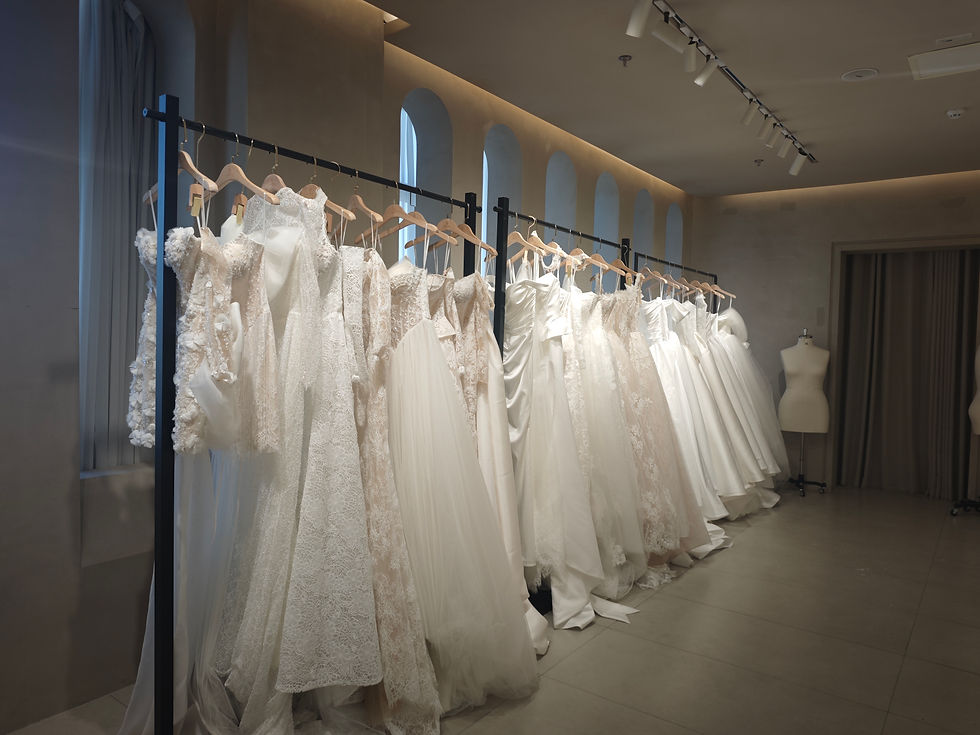
The “Layer Stack” Rule: Fit is a feeling, and layers are the source
Here’s the simplest way I explain it to buyers and stylists:
Silhouette is the outline. Layering is the experience.
A gown’s layer stack controls:
weight distribution (does it hang from the waist, the hip, the bust?)
shape memory (does it rebound, collapse, crease, or stay crisp?)
movement (swish vs. drag vs. bounce)
touch (soft, airy, structured, prickly, plasticky—yes, brides notice)
opacity (especially under boutique lighting and phone cameras)
If you want fewer “fit surprises,” you don’t just pick a fabric. You pick a fabric with the right support layers behind it.
Wedding dress fabric layering for A-line: how to make it float instead of flop
A-line is the most forgiving silhouette—until it isn’t.
When A-line is layered well, it feels effortless: the skirt floats, the waist looks clean, the bride moves without fighting the dress. When it’s layered poorly, you get:
a skirt that collapses between the legs
a waist seam that twists
a hem that looks “tired” by the end of the day
photos where the skirt reads flat instead of dimensional
The A-line layer stack that usually wins in fittings
Think in three zones:
1) Bodice (support + comfort):
comfortable lining against skin (soft, breathable handfeel)
light structure where needed (so the bust sits where it should)
smooth foundation so outer fabric doesn’t ripple
2) Waist/hip transition (the “no-bunch zone”):
stable interlining so the waist seam stays crisp
controlled bulk (too thick here = “Why do I look wider?”)
3) Skirt (shape + movement):
soft tulle for volume without scratch
optional stiffer layer lower down to hold shape
clean hem finish so it doesn’t feel like a sandbag
A-line styling tip for bridal shops
If your bride says, “I want A-line but I still want drama,” the answer usually isn’t “more lace.” It’s a smarter skirt stack—a little more internal lift, placed lower, so the waist stays clean.
That’s the kind of layering that looks expensive without shouting.
Wedding dress fabric layering for fishtail/mermaid: where comfort goes to die (unless you engineer it)
Mermaid gowns are confidence machines… and comfort tests.
I’ve seen brides fall in love with a fishtail and then instantly panic because:
they can’t sit
they can’t take a normal step
the skirt pulls the bodice down
the seam allowance feels like sandpaper
the hem catches on everything like it has a personal grudge
This is where wedding dress fabric layering becomes non-negotiable.
Mermaid needs “flex zones”
A good fishtail doesn’t just sculpt—it releases in the right places.
Key areas where layering matters:
upper hip to mid-thigh: too stiff = walking is miserable
knee break point: wrong reinforcement = awkward buckling
lower skirt flare: wrong net = flare collapses, looks limp
inner thigh seams: wrong lining = irritation + complaints
The mermaid layer stack that improves the fitting experience
supportive foundation through bodice + upper hip
controlled stretch/softness where the bride moves (especially hip/upper thigh)
stable flare support below the knee so the silhouette reads clearly in photos
smooth lining choices so seams don’t feel aggressive against skin
Mermaid styling tip for bridal shops
When a bride says, “I love mermaid, but I don’t want to feel trapped,” don’t down-sell her into a different silhouette right away.
Try this instead:
keep mermaid
adjust layer strategy (softer inner layers, smarter reinforcement, cleaner seam comfort)
A mermaid can feel wearable. But only if it’s built that way.
Satin: the gorgeous liar (and why backing layers matter)
Satin is stunning. It’s also brutally honest.
Satin shows:
every ripple
every lump
every seam shadow
every “tiny” fit issue the bride didn’t know she had
That’s why satin gowns live or die on what’s underneath.
Satin layering that makes a bride feel “smooth”
supportive lining with a clean surface (so satin glides, not grabs)
stable interlining at bodice and waist to prevent collapsing
controlled structure so the gown doesn’t crease like a paper bag when she sits
thoughtful seam finishing so nothing prints through
Satin layering that causes boutique headaches
thin lining that clings (hello, static + discomfort)
too-soft foundation that wrinkles under the satin
bulky seam work that creates visible ridges in photos
Satin styling tip for bridal shops
In the fitting room, satin needs lighting and movement tests:
have her sit
have her walk
take one quick phone photo from the side
Satin will tell you the truth immediately—and the layer stack is usually the reason.
Mesh: the “it looks light” fabric that can feel complicated fast
When people say “mesh,” they usually mean one of three things:
illusion mesh (necklines, sleeves, backs)
soft mesh (draping, overlays, gentle shaping)
structured mesh/net (support, containment, shaping)
And each one changes the fitting experience dramatically.
Mesh layering that feels premium
skin-friendly mesh with stable stretch recovery
clean edge finishing (so it doesn’t itch or roll)
smart reinforcement at stress points (buttons, zippers, armholes)
matching tone choices so it blends naturally under boutique lighting
Mesh layering that triggers complaints
scratchy mesh against underarm and neckline
unstable mesh that grows during the day
visible seam shadows (especially on lighter tones)
mismatch between mesh tone and lining tone (looks off in photos)
Mesh styling tip for bridal shops
If a bride is sensitive to fabric, mesh is the first place she’ll notice discomfort—especially at armholes and necklines. The right layering and finishing prevents the “I love it, but it’s itchy” objection.
The fitting-room translation: how to talk about layering without sounding technical
Brides don’t want a lecture on interlinings. They want confidence.
Here are simple phrases that work:
“This dress has a lighter inner layer, so it moves more.”
“This one has more support underneath, so the waist stays cleaner.”
“That crisp look comes from the structure inside—not just the fabric.”
“If you want more comfort through the hip, we adjust what’s underneath.”
“Satin needs a smoother base so it photographs clean.”
You’re not selling “layers.” You’re selling how she’ll feel wearing it.
A practical layering checklist bridal shop owners can use when choosing samples
When you’re selecting styles for your boutique (or evaluating a factory), these questions save time:
For A-line
Does the skirt hold shape after multiple try-ons?
Does the waist stay flat, or does it twist/crease?
Is volume coming from smart layering or just bulk?
For mermaid/fishtail
Can a bride walk normally? Sit normally?
Does the flare stay lifted, or collapse?
Are seams comfortable at inner thigh and hip?
For satin
Does it wrinkle aggressively when seated?
Are seam ridges visible under lighting?
Is the inner surface smooth enough for comfort?
For mesh/illusion
Does it itch at the neckline/armhole?
Does it blend well under boutique lighting?
Does it stretch out after handling?
These are fitting-room realities—exactly what your buyers and stylists care about.
Where Huasha helps (especially for boutiques that care about the “feel”)
At Huasha, we spend a lot of time on the part customers don’t see at first glance—because that’s what determines the try-on experience.
When we develop gowns for bridal shop owners, we focus on:
stable layer stacks that match the silhouette’s needs
fabric + lining combinations that support comfort and clean photos
reliable auxiliary materials and consistent construction standards
clear communication so you know what’s inside the gown—not just what’s outside
If you’re building a collection and you want the fittings to feel better (and the post-sale issues to drop), layering is the lever.
Want a quick “layer stack” recommendation for your next assortment?
If you tell me:
the silhouette (A-line or mermaid)
the outer fabric (satin/mesh/lace)
and the price-positioning vibe of your boutique (clean minimal vs. romantic detailed)
…I’ll share a practical layering direction you can use in your factory conversations.
Just DM me.


Comments