


Top 10 Wedding Dress Manufacturers and Bridal Brands to Know in China
- Rui Tsai

- 1 day ago
- 18 min read
A wedding dress can look almost weightless.
The business behind it is anything but.
Behind every clean neckline, floating skirt and carefully placed lace appliqué is a long chain of decisions: design, fabric, pattern, structure, handwork, fitting, production, inspection and delivery.
When all those decisions work together, the gown feels effortless.
When they do not, everyone notices.
I have worked in bridal production for nearly two decades, and one scene has stayed familiar throughout those years. A buyer walks into a showroom, sees a beautiful gown and immediately asks:
“Can you make something like this?”
It sounds like a simple question.
But what is she really asking?
Can the factory reproduce the fit in different sizes? Can the lace be reordered next season? Will the bodice still feel supportive after the pattern is graded? Can the design remain distinctive without becoming too difficult for a boutique to sell?
And, perhaps most importantly:
Can the company behind the gown turn a beautiful idea into a reliable business?
That is why I do not think China’s bridal industry can be understood through factory directories alone.
China has large-scale manufacturers, boutique-focused production partners, designer-led bridal labels and couture houses whose work influences the way an entire market thinks about shape, detail and craftsmanship.
Some make gowns for other brands.
Some build their own design language.
A few do both.
This guide brings those different parts of the industry together.
It is not a ranking based on revenue, company size or social-media followers. Think of it as a practical map of ten wedding dress manufacturers and bridal brands worth knowing—whether you are building a private-label collection, buying for a bridal store or simply trying to understand where Chinese bridal design is heading.
What Makes a Bridal Company Worth Knowing?
Before I introduce the companies, I should explain the lens I am using.
A bridal business does not earn long-term attention simply by producing one beautiful campaign.
I look for something deeper:
A recognizable design point of view
Strong understanding of bridal construction
Consistency between design and execution
Relevance to the modern fitting room
A clear place within the bridal market
The ability to influence buyers, designers or manufacturers
A meaningful connection to China’s bridal industry
Not every name in this article is a private-label supplier.
That distinction matters.
Some are production partners. Some are Chinese designer brands. Some are international houses with a strong presence or influence in China.
They should not be evaluated by exactly the same standards.
You would not judge a couture gown by how quickly it can be reordered, just as you would not choose a private-label factory based only on its runway photographs.
Different businesses. Different jobs.
With that understood, let us begin with the company I know most closely.
1. Huasha Bridal — Where Design Meets Practical Manufacturing
I will be transparent from the beginning: I am the CEO of Huasha Bridal.
That means I know this company from the inside—not only through finished photographs, but through production meetings, fitting corrections, fabric delays, quality inspections and the occasional long discussion over a neckline that is still two centimeters away from being right.
Huasha is based in Suzhou and focuses on white-label, private-label and ODM wedding dress production for physical bridal boutiques, bridal retail groups and international brands.
Our role is not the same as that of a couture house.
We are expected to make beautiful gowns, of course. But we are also expected to repeat them consistently, grade them across multiple sizes, control quality and deliver them when the buyer needs them.
That is where manufacturing becomes real.
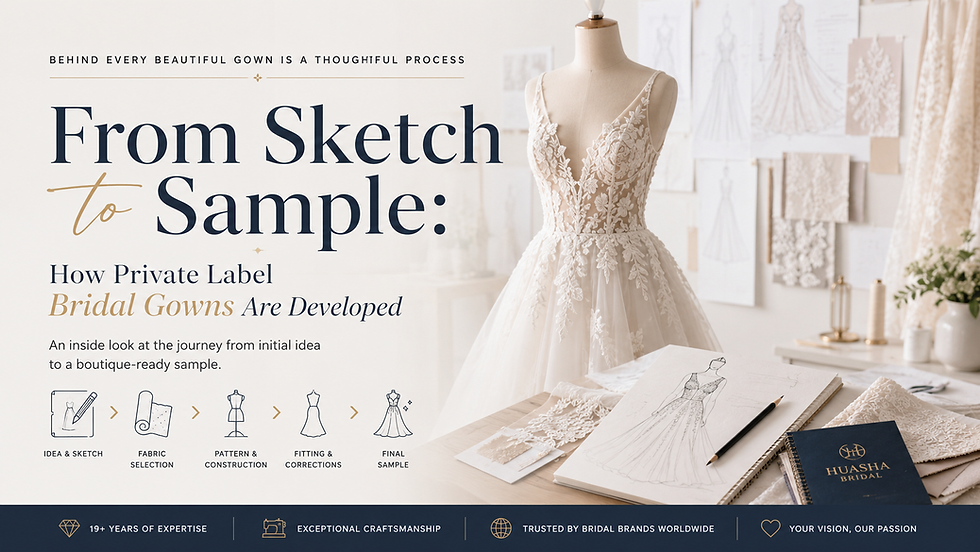
A design may look perfect on a sketch, yet behave completely differently once it is made in lace, satin or layered tulle. A soft bodice may need stronger boning. A beautiful neckline may sit too low in a larger size. A train may photograph beautifully but become difficult to manage in a fitting room.
Our job is to solve those problems before they reach the boutique.
What Huasha Bridal is known for
Original bridal gown development
White-label and private-label programs
OEM and ODM production
In-house coordination from pattern to packaging
Flexible ordering with no minimum order on white-label styles
Standard and plus-size bridal gown production
Design modifications for boutique needs
Pre-shipment quality inspection
Production support for growing bridal businesses
Huasha is especially relevant to boutique owners who want to test individual gowns before making a larger commitment.
That flexibility matters.
I have seen stores become trapped by large opening orders filled with styles they had never tested on real brides. The dresses looked excellent in the line sheet. Six months later, half of them were still taking up space on the rail.
Inventory is not decoration.
Every sample needs a reason to be there.
For that reason, I believe a strong manufacturing partner should help a boutique grow carefully—not pressure it to buy more gowns than it can realistically sell.
Best known for: Flexible white-label production, original ODM development and boutique-focused manufacturing.
What bridal buyers can learn: Good production is not only about making the first sample well. It is about protecting the fit, materials and construction when the gown is reordered.

2. Adrianna Conti — Classic Bridal Beauty with Commercial Appeal
Some bridal brands chase attention.
Others understand the quieter power of familiarity.
Adrianna Conti is a name associated with classic bridal language: romantic silhouettes, recognizable proportions and gowns that do not need a five-minute explanation before a stylist can bring them into the fitting room.
That kind of design can look easy.
It rarely is.
The challenge with classic bridal is that there is nowhere for weak execution to hide. When a gown is built around clean lines, soft lace or a familiar A-line silhouette, every proportion matters.
The neckline has to feel balanced.
The waist must sit correctly.
The skirt needs enough volume to feel bridal, but not so much that the bride disappears inside it.
In my experience, these are often the gowns that quietly support a boutique’s business. They may not always receive the loudest reaction on Instagram, but they can become dependable fitting-room performers.
Why Adrianna Conti is worth watching
Classic and romantic bridal direction
Familiar, commercially accessible silhouettes
Styling that can fit naturally into a boutique assortment
A balance between visual elegance and wearability
Relevance for stores serving traditional yet modern brides
Independent public information about Adrianna Conti is limited compared with larger international bridal houses. Buyers considering any direct commercial relationship should therefore verify its current company structure, distribution model and production capabilities independently.
Still, as a design reference, the name represents an important lesson:
Commercial does not have to mean ordinary.
The best classic wedding dresses feel familiar enough to trust and distinctive enough to remember.
Best known for: Timeless bridal styling and approachable romantic silhouettes.
What bridal buyers can learn: A collection needs dependable gowns, not only statement pieces. The dresses that look less dramatic in a campaign may become the gowns stylists reach for most often.
3. CHEYENNE CAI — A Designer-Led Bridge Between Markets
A bridal designer does more than draw dresses.
She decides what kind of woman the collection sees.
Is she romantic or restrained? Traditional or fashion-led? Does she want to feel delicate, powerful—or somehow both at once?
CHEYENNE CAI represents a designer-first approach to bridal fashion, shaped by experience across different markets and design cultures.
Her work is connected to the development of LAFINE COUTURE and Calista Couture, bringing together Parisian influence, international bridal experience and an understanding of how gowns must perform beyond a fashion image.
That last part matters to me.
A wedding dress does not live only on a runway.
It lives under boutique lighting. It is handled by stylists. It is tried on by women with different proportions, preferences and levels of confidence.
The strongest bridal designers understand both poetry and practicality.
What defines the CHEYENNE CAI perspective
Couture-inspired bridal design
A blend of modern structure and romantic detail
International influences across Europe, Asia and the United States
Attention to how gowns present in a boutique environment
A designer-led approach to silhouette, proportion and storytelling
Experience connecting creative direction with production realities
One of the most difficult things in bridal design is knowing when to stop.
More lace does not always create more luxury.
More volume does not always create more emotion.
More embellishment can sometimes make a gown feel less special, not more.
A mature designer knows when the dress has said enough.
CHEYENNE CAI’s value within this list comes from that design perspective: bridal fashion needs a clear identity, but it also needs discipline.
Best known for: International bridal design, couture-influenced collections and a refined balance between romance and structure.
What bridal buyers can learn: A recognizable design identity makes a collection easier to merchandise, explain and remember.
4. WE COUTURE — Modern Chinese Bridal with a Clear Point of View
WE COUTURE was founded in Shanghai by designers Demi Jiong and Derek Wong.
Its origin story begins in a converted warehouse loft—a setting that feels appropriate for a brand built around experimentation, architecture and modern Chinese bridal expression.
WE COUTURE does not approach bridal design as if every bride is waiting for the same princess gown.
Its work often feels sharper and more self-aware.
There is romance, but it is not always sweet.
There is structure, but it is not necessarily rigid.
There is drama, yet the drama often comes from proportion, fabric or shape rather than decoration alone.
That makes WE COUTURE important within China’s bridal landscape.
It represents a generation of Chinese bridal brands that are not simply interpreting established Western trends. They are developing their own visual language.
What makes WE COUTURE stand out
A strong contemporary design identity
Modern bridal silhouettes
Architectural use of shape and volume
A balance of minimalism and theatrical detail
A clear connection to Shanghai’s creative fashion culture
Bridal collections designed as complete visual stories
For boutique buyers, WE COUTURE offers a useful reminder: a gown does not need to please everyone.
In fact, trying to please everyone is often how collections become forgettable.
The best brands know their woman.
They understand what she notices, what she avoids and what she wants to feel when she sees herself in the mirror.
Best known for: Contemporary Chinese bridal design with modern structure and artistic direction.
What bridal buyers can learn: A focused collection with a clear customer is often stronger than a broad collection trying to cover every possible taste.
5. LAFINE COUTURE — Parisian Romance Seen Through an International Lens
LAFINE COUTURE was founded in Paris in 2004 by designer Cheyenne Cai.
Its design world is built around femininity, refined detailing and the emotional language of couture.
But “romantic” is one of the most overused words in bridal fashion.
Almost every lace gown is described as romantic. So is every soft skirt, floral appliqué and delicate sleeve.
Real romance needs more than decoration.
It needs atmosphere.
It is the way fabric falls from the waist. The softness of the color. The pause between a fitted bodice and a skirt opening into movement.
LAFINE COUTURE is worth knowing because it treats bridal design as an emotional experience rather than a list of features.
What characterizes LAFINE COUTURE
Paris-influenced bridal aesthetics
Feminine and refined silhouettes
Couture-inspired surface detail
Handcrafted embellishment
A blend of classic romance and modern polish
Strong visual storytelling
For manufacturers, a brand like LAFINE also offers an important technical lesson.
Soft-looking gowns are not necessarily simple to make.
A gown that appears light may contain carefully engineered support. A skirt that seems to float may require several precisely balanced layers. Delicate lace placement may take longer than a heavier, more obvious embellishment.
Effortless beauty often requires considerable effort.
That is the joke bridal production plays on us.
The easier a gown looks, the harder the team may have worked to make it feel that way.
Best known for: Refined couture romance and Paris-influenced bridal storytelling.
What bridal buyers can learn: Romantic gowns sell best when the emotion comes from proportion, movement and texture—not simply from adding more lace.
6. SHINE MODA — Fashion-Forward Bridal from Shanghai
SHINE MODA is a Shanghai-based made-to-measure bridal brand associated with modern, fashion-conscious wedding design.
Its visual identity has often leaned toward a cleaner, more controlled kind of luxury.
Not cold. Not plain.
Intentional.
That distinction is important because minimal bridal design has become crowded.
Many gowns now use the same vocabulary: clean satin, square neckline, fitted waist, dramatic train.
But removing decoration does not automatically create sophistication.
When a dress is minimal, the fabric must carry more responsibility. So must the cut. So must the pattern.
There is no beadwork available to distract the eye from an uneven seam.
Why SHINE MODA is worth knowing
Shanghai-based made-to-measure bridal positioning
Modern, fashion-led styling
Interest in clean lines and sculptural shapes
A restrained approach to embellishment
Editorial presentation
Relevance to brides seeking a less traditional look
SHINE MODA’s flagship retail environment has also reflected this ordered, minimalist identity, showing how store design and gown design can speak the same language.
That is something bridal brands often overlook.
A collection does not exist separately from the room in which it is sold.
A highly romantic collection may need warmth and softness around it. A modern architectural gown may look stronger in a cleaner environment.
Brand identity is not only stitched into the dress.
It is also built into the space, photography, packaging and way the stylist introduces the gown.
Best known for: Modern made-to-measure bridal design with a fashion-forward Shanghai perspective.
What bridal buyers can learn: Your gowns, showroom and visual content should feel as if they belong to the same brand.
7. Artico Sima — Bridal Design as Wearable Art
Artico Sima occupies a more artistic corner of the bridal market.
The name is associated with couture-led gowns, expressive color, embroidery, floral detail and collections that borrow ideas from painting, nature and visual art.
This is bridal fashion for buyers who believe a wedding gown can do more than flatter the body.
It can create a world.
Of course, there is a practical tension here.
The more artistic the gown, the more carefully a boutique must understand its customer.
A dramatic couture piece may attract attention, create beautiful content and bring energy to a showroom. But it may not sell in the same volume as a clean A-line or familiar lace mermaid.
That does not make it less valuable.
It simply gives it a different job.
What makes Artico Sima interesting
Art-led bridal and couture direction
Expressive embroidery and surface detail
Floral and painterly references
Strong collection concepts
Gowns designed for visual impact
A more experimental approach to bridal color and texture
Public corporate information about Artico Sima is limited, so it should be understood primarily as a design-led bridal name rather than being presented as a verified large-scale manufacturer.
For boutique buyers, the practical lesson is assortment balance.
A store needs gowns that convert.
It may also need one or two gowns that make people stop walking.
Those are not always the same dresses.
Best known for: Artistic bridal concepts, expressive texture and couture-style visual storytelling.
What bridal buyers can learn: Statement gowns can earn their place through attention, appointments and brand positioning—even when they are not the highest-volume sellers.
8. LANYU — Chinese Craftsmanship Reimagined Through Couture
LANYU, founded by Chinese designer Lan Yu, is one of the most recognizable names in modern Chinese couture and bridal fashion.
Her work is particularly associated with the use of traditional Suzhou embroidery alongside Western couture techniques and silhouettes.
This combination matters.
Chinese bridal fashion becomes most interesting when it stops asking how closely it can resemble Europe and begins asking what only China can contribute.
Suzhou embroidery carries generations of knowledge: thread control, shading, patience and visual storytelling.
Couture construction brings another set of disciplines: proportion, draping, internal support and hand finishing.
When those traditions meet thoughtfully, the result is not simply “East meets West,” a phrase used so often it has almost lost its meaning.
It becomes something more personal.
What defines LANYU
Chinese couture and bridal design
Traditional Suzhou embroidery
A combination of Eastern craft and Western construction
Red-carpet and international fashion visibility
Feminine silhouettes with strong cultural references
A clear designer-led identity
LANYU reminds manufacturers and bridal buyers that heritage should not be treated like decoration.
Adding one traditional motif does not automatically give a gown cultural depth.
The technique, material and story must feel connected to the shape of the dress.
Otherwise, it is just an ornament looking for a reason to be there.
Best known for: Bringing traditional Chinese embroidery into contemporary couture and bridal fashion.
What bridal buyers can learn: Cultural craftsmanship is strongest when it is built into the design—not added at the end as a marketing detail.
9. Vera Wang — The Global Bridal Benchmark with a Strong China Presence
Vera Wang is not a Chinese bridal brand.
She is an American designer, and her company is an international luxury house.
So why include Vera Wang in an article about bridal names to know in China?
Because influence does not always follow nationality.
Vera Wang has had a significant presence in the Chinese luxury bridal market, with bridal locations in cities including Shanghai, Beijing, Chengdu and Wuhan.
More importantly, the brand has influenced how many brides, stylists and designers understand modern luxury bridal.
Before Vera Wang, bridal was often discussed through tradition first and fashion second.
Her work helped reverse that order.
The wedding dress could be bridal and directional. Romantic and slightly rebellious. Soft, yet never passive.
What Vera Wang represents in China’s bridal market
A global luxury bridal benchmark
Strong brand recognition among fashion-conscious brides
Bridal salons and services in major Chinese cities
A design language that treats bridal as fashion
Dramatic use of proportion, layering and contrast
The commercial power of a recognizable designer identity
From a business perspective, Vera Wang also demonstrates what happens when a bridal name grows beyond gowns.
The brand extends into fragrance, jewelry, eyewear, home products and other lifestyle categories.
Not every bridal company should do this.
Most should not.
But the lesson is valuable: a strong bridal brand is built around a world, not only a product.
Best known for: Turning modern bridal design into a globally recognizable luxury language.
What bridal buyers can learn: A powerful brand makes its point of view recognizable before the customer even reads the label.
10. Guo Pei — Chinese Couture at Its Most Ambitious
Guo Pei is not a conventional bridal manufacturer, and evaluating her work through the language of wholesale production would miss the point entirely.
She is one of China’s most acclaimed couturiers, known for monumental silhouettes, intricate embroidery, extraordinary handwork and designs that often sit somewhere between clothing, sculpture and visual mythology.
Her work asks a different question from most commercial bridal collections.
Not:
“Will this become a bestseller?”
But:
“How far can craftsmanship go?”
That question matters even to businesses producing more commercial gowns.
Couture expands the imagination of the entire industry.
A technique seen in an extraordinary runway piece may later influence an appliqué, sleeve, corset or embroidery pattern in a more wearable collection.
The runway and the fitting room are not the same place.
But they do speak to each other.
What defines Guo Pei’s influence
More than three decades of couture work
Deep engagement with Chinese cultural heritage
Monumental silhouettes
Highly complex embroidery and embellishment
International recognition
A philosophy that connects Chinese tradition with global couture practice
Guo Pei’s work also reminds us that craftsmanship has emotional power.
A hand-embroidered surface communicates time.
A sculpted silhouette communicates intention.
A gown made through hundreds or thousands of hours of labor feels different because it carries the evidence of those hours.
That level of couture is not realistic for most wholesale collections.
But its discipline can still inspire them.
Best known for: Ambitious Chinese couture, extraordinary craftsmanship and globally recognized visual storytelling.
What bridal buyers can learn: Luxury is not created by adding more decoration. It comes from intention, originality and the quality of execution.
Quick Comparison: Wedding Dress Manufacturers and Bridal Brands to Know
Name | Primary Position | Connection to China’s Bridal Market | Most Relevant For |
Huasha Bridal | Manufacturer and private-label partner | Suzhou-based bridal production | Boutiques, retail groups and growing private labels |
Adrianna Conti | Design-led bridal name | Classic bridal reference within the market | Buyers seeking commercial romantic styling |
CHEYENNE CAI | International bridal designer | Design and brand development across multiple markets | Designer-led collection planning |
WE COUTURE | Chinese bridal designer brand | Founded in Shanghai | Contemporary and artistic bridal inspiration |
LAFINE COUTURE | Couture bridal brand | International brand connected to Chinese bridal design leadership | Refined romance and couture detailing |
SHINE MODA | Made-to-measure bridal brand | Shanghai-based bridal presence | Modern and fashion-forward bridal styling |
Artico Sima | Artistic couture bridal name | Design-led presence in the Chinese bridal market | Statement gowns and artistic collection concepts |
LANYU | Chinese couture designer brand | Chinese craft and Suzhou embroidery | Cultural craftsmanship and couture inspiration |
Vera Wang | American luxury bridal house | Strong salon presence and market influence in China | Global luxury branding and fashion-led bridal |
Guo Pei | Chinese couture house | One of China’s leading couture voices | Craftsmanship, heritage and creative ambition |
Manufacturer, Bridal Brand or Couture House: Why the Difference Matters
One of the biggest mistakes I see in bridal sourcing is comparing completely different companies as though they offer the same service.
They do not.
A wedding dress manufacturer
A manufacturer is responsible for turning approved designs and specifications into repeatable products.
Its performance should be judged by:
Sample accuracy
Pattern control
Size grading
Material consistency
Quality systems
Lead times
Repeat-order stability
Communication
Delivery performance
A private-label or ODM partner
A private-label or ODM partner does more than assemble gowns.
It may also support:
Design development
Fabric sourcing
Pattern creation
Modifications
Branding
Packaging
Product photography
Collection planning
This is the category in which Huasha Bridal primarily works.
A bridal designer brand
A designer brand develops and sells its own creative identity.
It should be evaluated by:
Design direction
Collection consistency
Market positioning
Retail support
Brand recognition
Customer relevance
A couture house
A couture house operates at the most artistic and labor-intensive end of fashion.
Its work may influence bridal design without being intended for conventional wholesale or scalable production.
Understanding these differences saves buyers from asking the wrong questions.
You should not ask a couture house for factory-direct private-label pricing.
You should not choose a production partner solely because its campaign resembles couture.
And you should never assume that a famous brand’s design influence means it offers manufacturing services to other labels.
What Growing Bridal Brands Can Learn from These Ten Names
Although these companies occupy different positions, together they reveal several useful lessons.
1. A collection needs a clear identity
A buyer should be able to describe the collection in one or two sentences.
Is it modern and architectural?
Soft and romantic?
Clean and commercially focused?
Couture-led and expressive?
When every gown tells a different story, the collection becomes difficult to merchandise.
2. Beautiful design must survive production
A gown is not successful because the sketch is beautiful.
It succeeds when the sample fits, the bulk order remains consistent and the reorder still looks like the original.
Design and manufacturing cannot live in separate rooms.
They need to argue with each other occasionally.
That is healthy.
The designer protects the vision. The production team protects reality. The best gown appears somewhere in the conversation between them.
3. Cultural identity should feel genuine
Chinese bridal design does not need to hide its origin in order to feel international.
LANYU and Guo Pei demonstrate that Chinese craft can speak to a global audience when it is used with confidence and depth.
The goal is not to place a Chinese symbol on a Western silhouette.
The goal is to create a design in which the technique, material and story belong together.
4. Commercial gowns and statement gowns have different jobs
A boutique collection needs balance.
Some gowns bring people through the door.
Some help stylists begin an appointment.
Some make the bride feel secure immediately.
Others create the final emotional moment.
Do not expect every dress to perform the same role.
5. Reliability is part of design
Buyers often separate design from operations.
I do not.
A gown that arrives too late has failed as a product, no matter how beautiful it is.
A dress that cannot be reordered consistently has failed the boutique.
A design that looks excellent only in one sample size is unfinished.
Reliability may not appear in a campaign photograph, but it is one of the most important elements stitched into a commercially successful gown.
How to Evaluate Wedding Dress Manufacturers in China
If your goal is sourcing rather than design research, use this list as a starting point—not as a substitute for due diligence.
Before choosing a manufacturing partner, ask the following questions.
Who actually makes the gowns?
Confirm whether the company is:
A factory
A trading company
A designer brand
A sourcing agency
Or a combination of these
There is nothing automatically wrong with working through a trading company.
The problem begins when the business model is hidden.
Which processes are completed in-house?
Ask who handles:
Design
Patternmaking
Sampling
Cutting
Sewing
Embroidery
Beading
Finishing
Inspection
Packing
A supplier should be able to explain the production flow clearly.
How is the approved sample protected?
Clarify:
Measurement tolerances
Fabric and lace codes
Color standards
Embellishment placement
Boning and internal construction
Packing requirements
Approval procedures for substitutions
“Similar material” is not a specification.
How does the factory handle different sizes?
Do not evaluate fit using only one small sample.
Ask how the pattern is graded and how support changes across sizes.
A size 24 bodice should not simply be an enlarged size 6.
Larger sizes may require different boning, cup placement, seam support and internal engineering.
What happens when something goes wrong?
Every production system eventually encounters a problem.
The important question is not whether a supplier claims to be perfect.
It is whether the supplier has a clear process for:
Identifying the cause
Communicating the issue
Correcting the gown
Preventing repetition
Protecting the delivery date where possible
A company that promises there will never be a problem is probably selling confidence rather than operating a system.
Frequently Asked Questions
Which city in China is best known for wedding dress manufacturing?
Suzhou is one of China’s most established wedding dress centers, with a deep supply chain for bridal fabrics, lace, accessories, patternmaking and gown production.
Guangzhou and other apparel-production areas also play important roles, particularly in formalwear, embellishment and export manufacturing.
Location alone, however, does not prove quality.
A factory must still be evaluated through samples, production processes and quality controls.
Are all the companies in this article private-label manufacturers?
No.
Huasha Bridal is included as a manufacturer and white-label, private-label and ODM partner.
Other names in the article are primarily designer brands, made-to-measure labels or couture houses. Vera Wang is an American luxury bridal brand with a significant presence in China.
The article combines these categories because all ten contribute something meaningful to understanding China’s bridal market.
What is the difference between white label and private label?
White label usually means selecting an existing manufacturer-developed gown and selling it under your own store or brand name.
Private label can include existing gowns, exclusive modifications, branding, packaging or more differentiated product arrangements.
The terms are not used consistently across the industry, so buyers should define exactly what is included before ordering.
What does ODM mean in bridal manufacturing?
ODM stands for original design manufacturing.
In bridal, it often means the manufacturer participates in developing the product, including the silhouette, fabric, construction, pattern and sample.
The finished gown may then be sold under the buyer’s brand, depending on the commercial agreement.
How can a bridal boutique reduce the risk of sourcing from China?
Begin with samples and small orders.
Inspect the inside of the gown, not only the photographs. Confirm measurements, materials and construction in writing. Arrange a live factory video tour or physical visit where possible.
Most importantly, do not rush from a successful first sample into a large order without testing consistency.
One good gown proves craftsmanship.
A good repeat order begins to prove the system.
Final Thoughts
China’s bridal industry cannot be explained by one label.
It includes factories capable of supporting growing private-label businesses. It includes Shanghai designer brands with modern creative identities. It includes artisans protecting traditional embroidery and couture houses pushing craftsmanship far beyond ordinary production.
It also exists within a global market where international names such as Vera Wang continue to influence how Chinese brides and designers understand luxury.
For bridal boutique owners and buying teams, the lesson is not to search for one company that does everything.
Look for the right partner for the right job.
Go to a designer brand for a clear creative point of view.
Study couture for craftsmanship and ambition.
Choose a manufacturer for technical execution, consistency and delivery.
And when you are building your own private-label collection, find a production partner that understands what is really at stake.
Because the label sewn into the gown is yours.
The bride will never meet the patternmaker, seamstress, embroidery artisan or quality inspector who helped make it.
She will remember your store.
That is why production matters.
A factory is not simply making a dress on your behalf.
It is helping you keep a promise.

Comments