

What Fabric Tests Should Bridal Boutiques Request Before Ordering Delicate Wedding Gowns?

Before placing wholesale orders for delicate wedding gowns, bridal boutiques should request comprehensive fabric tests covering snagging, pilling, color migration, shrinkage, friction, steaming reaction, and transport recovery. Evaluating these properties ensures delicate bridal fabrics maintain structural integrity during fitting sessions, alterations, and long-distance shipping, protecting salon inventory from preventable damages.
Which core fabric integrity tests prevent snagging and pilling on delicate bridal gowns?
Bridal boutique sample dresses experience repeated handling during appointments, where jewelry, veil attachments, and styling clips can easily catch on fragile textiles. Conducting fabric snagging and pilling tests enables salon owners to verify how sheer tulles, fine chiffons, and delicate laces perform under contact and movement.
Key fabric integrity checks to request include:
Surface snag resistance: Evaluates how easily woven threads or delicate knit loops pull away when snagged by rings or sharp accessories.
Surface pilling assessment: Checks whether localized rubbing causes loose fibers to mat into visible fuzz or pills over time.
Friction and seam yarn slippage: Assesses whether tension across delicate seams causes weave separation or structural weakness along fitted silhouettes.
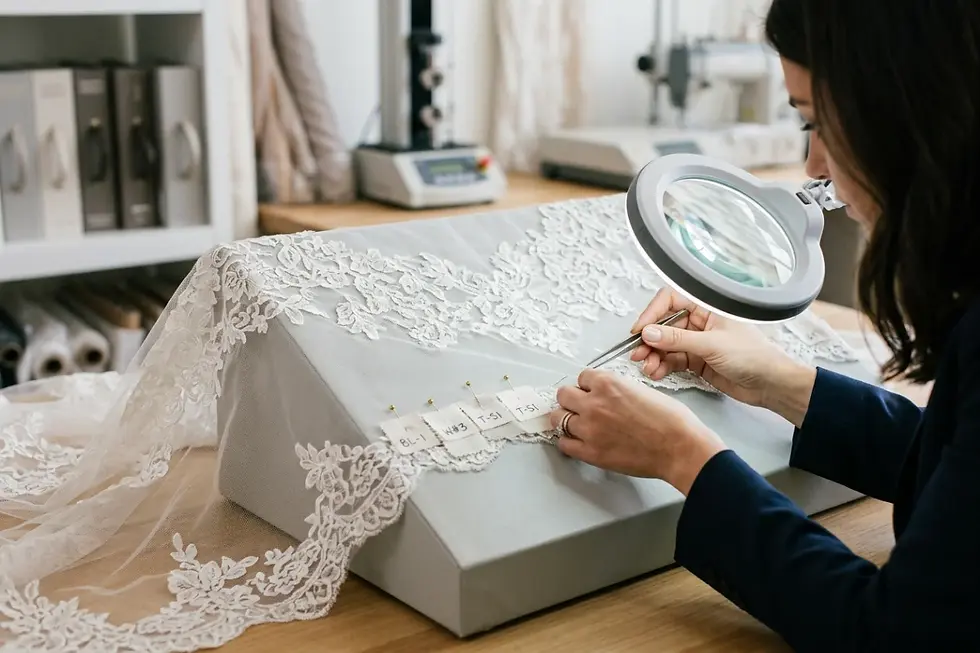
Snagging and pilling resistance tests protect bridal boutique sample dresses from jewelry catches.
Why is a bridal fabric color migration test vital for multi-layered wedding dresses?
Many modern wedding dresses feature multi-layered constructions, such as ivory lace appliqués layered over nude illusion netting or blush lining. A bridal fabric color migration test ensures that dyed materials and contrasting trims remain stable without bleeding onto lighter layers.
Boutiques should evaluate two critical color transfer scenarios before confirming orders:
Assessment Area | Testing Focus | Risk of Skipping the Test |
|---|---|---|
:--- | :--- | :--- |
Dry and Wet Friction Transfer | Evaluates pigment rub-off caused by friction, skin contact, or humidity during wear. | Dark or colored linings staining pale outer gown layers. |
Interlayer Migration | Checks if dyes bleed across adjacent, touching fabrics under warm or humid storage conditions. | Unwanted color halos and permanent staining on delicate bridal lace and tulle. |
What wedding dress fabric quality checks ensure resilience during alterations and steaming?
Delicate wedding gowns require pressing, steaming, and customized seam modifications prior to a bride's wedding day. Requesting specific wedding dress fabric quality checks guarantees that fabrics respond safely to atelier heat, moisture, and alterations.
Essential heat and alteration assessments include:
Steaming reaction verification: Confirms that satins, organzas, and fine tulles do not melt, distort, lose luster, or water-spot when steamed.
Dimensional stability and shrinkage tests: Measures whether delicate gown panels shrink or warp during localized pressing or routine garment care.
Embellishment thread stability: Verifies that internal structural threads and beading supports maintain alignment without warping when heat is applied.
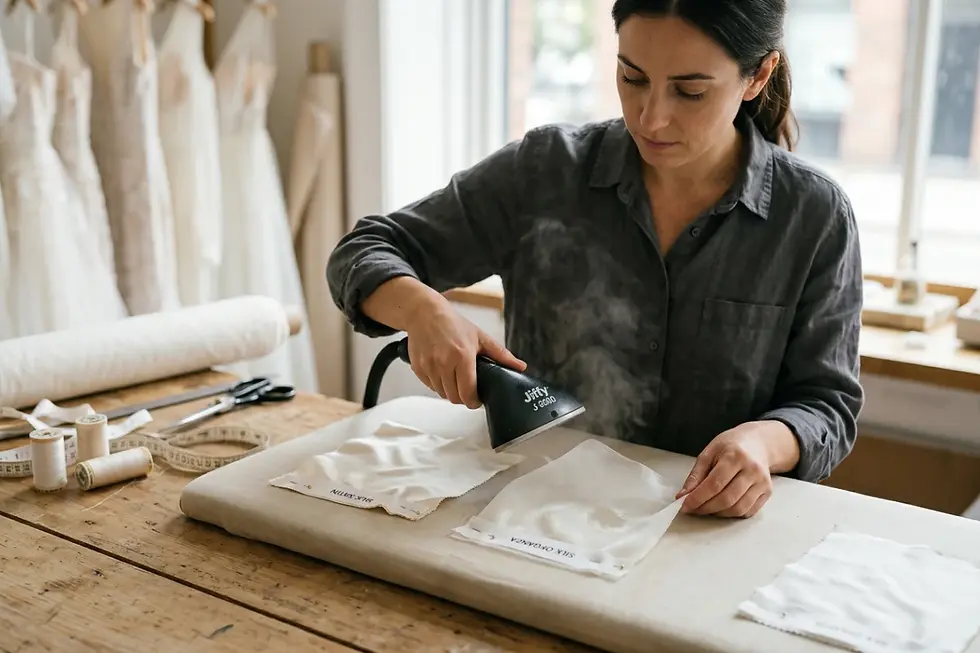
Steaming and shrinkage checks ensure delicate bridal gowns maintain dimensional stability during alterations.
Why should boutiques verify transport recovery and crease resistance?
Wedding dresses are often packed and shipped across long distances before reaching the boutique floor. Verifying transport recovery and crease resistance helps salon staff ensure that gowns regain their full shape quickly upon unpacking without extensive restoration.
Transport resilience testing confirms whether:
Horsehair hem braids, petticoats, and skirt linings bounce back to their structured volume after transit compression.
Delicate sheer overlays and layered trains release fold creases easily through standard hanging or gentle steaming.
Multi-layer skirts drape smoothly without developing static cling or uneven hemlines.
How should bridal boutiques request fabric quality documentation from manufacturers?
Boutique owners should establish systematic quality requirements during the initial sourcing stage to ensure consistent inventory performance across bulk production runs.
To establish clear quality standards, bridal boutiques should:
Identify the exact textile composition: Obtain the full fiber breakdown for all layers, including outers, illusion meshes, linings, and internal interfacings.
Specify core testing requirements: Clarify the specific fabric tests bridal boutiques should request in the purchase agreement or technical brief.
Review fabric swatch test results: Request physical swatches that have undergone shrinkage, steaming, and friction assessments.
Confirm production consistency: Ensure quality checks apply to full production dye lots rather than development samples alone.

Requesting comprehensive fabric testing documentation protects boutique inventory and customer satisfaction.
Implementing consistent bridal gown fabric testing protocols protects salon inventory, streamlines alterations, and ensures gowns remain flawless for every bride. Request fabric test information to review full textile testing specifications for upcoming bridal collections.
FAQ
Why is snagging testing critical for bridal boutique floor samples?
Boutique floor samples are tried on repeatedly by brides wearing jewelry and accessories. Snagging tests verify that delicate tulle and lace meshes will not pull or pill easily during routine boutique appointments.
What happens if a layered wedding gown skips color migration testing?
Without color migration testing, darker linings, colored embroideries, or dyed trims may bleed into white or ivory layers when exposed to humidity, body heat, or localized spot cleaning.
When should bridal boutiques request fabric test reports from gown suppliers?
Boutiques should request fabric test specifications and swatch reports prior to placing production purchase orders to confirm batch stability, alteration suitability, and transit durability.

Comments